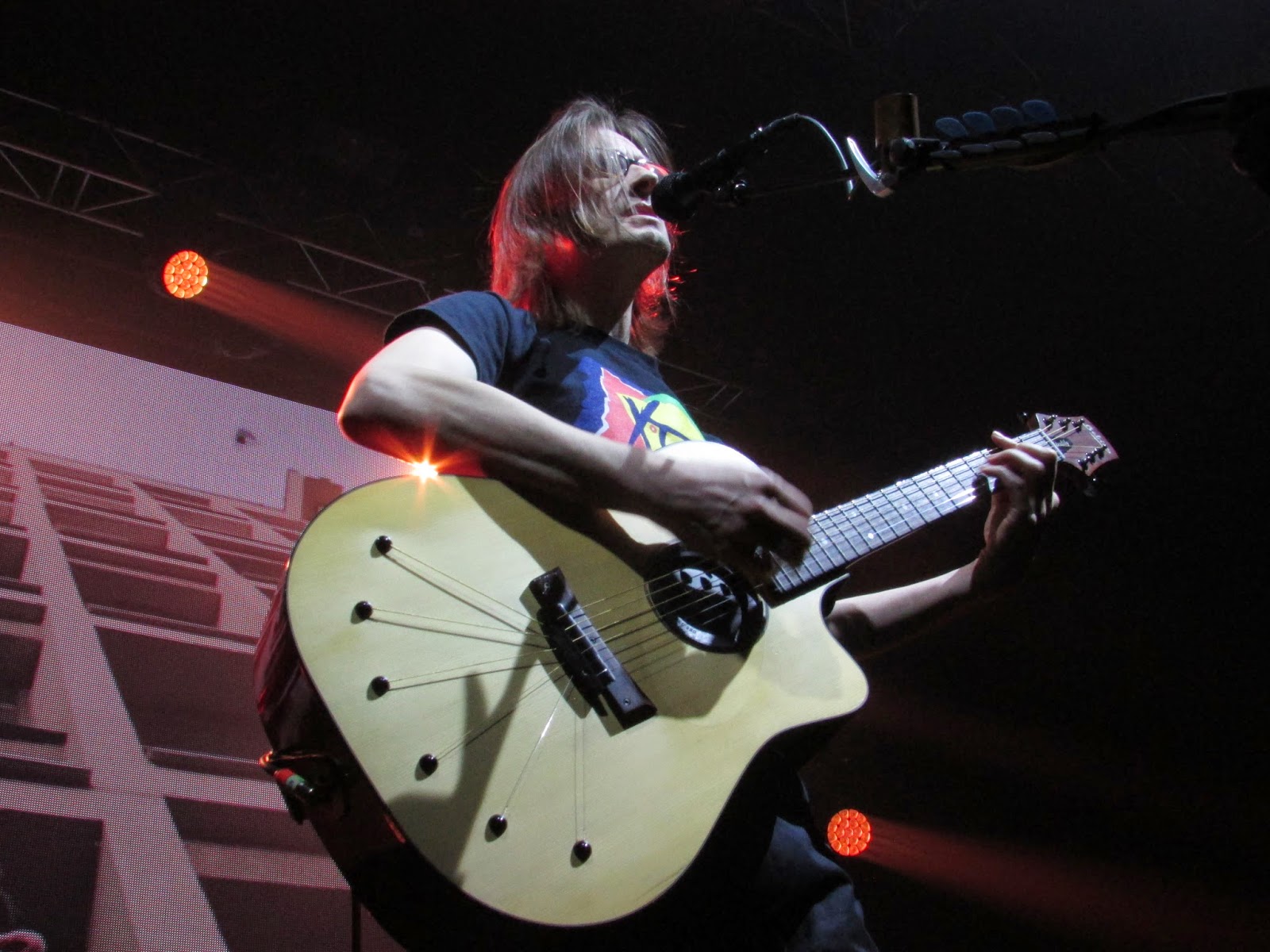
Considering his stature in the world of music
today, it should come to no surprise that this following interview with the
legendary musician and producer Steven Wilson had me quite nervous. After being
greeted by his friendly tour Manager, I was led through the labyrinthine
backstage of the beautiful Rockhal before being told to wait a few moments
while they checked whether the man was ready for his next interview. It was
about at this point that my usual relaxed state of being started to crack down.
Luckily though, the wait would only last a few moments and my anxiety would be
immediately swept away by Steven Wilsons' exceptionally down-to-earth,
laid-back and friendly vibe.
Considering his stature in the world of music
today, it should come to no surprise that this following interview with the
legendary musician and producer Steven Wilson had me quite nervous. After being
greeted by his friendly tour Manager, I was led through the labyrinthine
backstage of the beautiful Rockhal before being told to wait a few moments
while they checked whether the man was ready for his next interview. It was
about at this point that my usual relaxed state of being started to crack down.
Luckily though, the wait would only last a few moments and my anxiety would be
immediately swept away by Steven Wilsons' exceptionally down-to-earth,
laid-back and friendly vibe.
The main topic of the interview centered around
the storyline and themes to his freshly released solo effort
"Hand.Cannot.Erase", which has been making big waves from the fans
and in the music press thanks to Steven's audacious strive towards exploring
new musical territory, surprising and thrilling us with every new release.
For this interview, Steven Wilson agreed to treat us to a fascinating
track-by-track breakdown of the "Hand.Cannot.Erase", which he
describes as being his first veritable concept record.

"The album
is a concept record, which means that it has a narrative going from point A to
point B and it tells a story. The reason I say that is because some people
think of a concept album as any album that just has a theme, and I've done
albums in the past which have a theme to them, but not like this where it
actually tries to go from point A to point B, telling a story"
(Note: Some of the interview questions were
asked in the middle of the track-by-track breakdown. For the sake of
legibility, the questions and the album breakdown were separated. The original
spots in which the first 4 questions were asked are marked in parenthesis).
So First Regret is what you might consider
to be the "overture", the introduction to the record. It sets up one
of the main piano themes that will reoccur later in the record, and it acts as
an introduction to the story of this character.
The next
track, Three Years Older, introduces
us to our character. It talks about her childhood, her trials to find her
personality and what kind of a person she is. It creates an image of someone
who's quite isolated and who has always rejected other human interaction and
the idea of relationships and has become this kind of insular character. She's
not a sad character, because she is someone that has chosen to be alone. This
is not the idea of someone who's been rejected by society, quite the opposite, she has rejected society. 3 Years Older is a very long piece of
music, so it kind of sets up the whole story.
The title
track Hand Cannot Erase is really
about the idea of being in a relationship, not because you want to be in one
but because you feel it's somehow expected, that society expects you to couple.
I'm the kind of person who doesn't necessarily believe that that's right for
everyone. I don't think everyone is made to be in that situation.
So our character is talking about how it's this kind of illusion of love. It's
the illusion of love that you create for the outside world, for you parents,
for your friends, for society... But actually it's quite frustrating and most
of the time you're just waiting for that moment where you can be alone again.
So she's talking a lot about this relationship that she's in and how it’s
actually very frustrating and very stifling for her, and she can't wait for
those moments where she can be back on her own again. I'm sure everyone kind of
understands that feeling. In relationship there's usually someone that's more
into it that the other. It's very hard to get a relationship where both people
are equally into the situation. There's usually someone that's pushing a bit
harder and the other person can quite often get that feeling where they just
want to can't wait to get away from this situation and who's feeling slightly
stifled and smothered by the other person. So it's a song about that really.
Perfect Life is part of one of my long series of songs I've
written about nostalgia for childhood. As you get older, I think your nostalgia
for childhood becomes stronger. It's one of those things where when you're very
young, you can't wait to grow up, you can't wait to be an adult. But as you
become older, you begin to understand and comprehend that actually this was a
very special time in your life, probably the most special. It's a time of
innocence, discovery, wonder, everything is new. All of these experiences are
new experiences, which is a feeling you can never really recapture as an adult
and I think with that comes a certain sense of melancholia.
Nostalgia is a very interesting emotion because at the same time it's a happy feeling of looking back at something with a sense of happiness and warmth but at the same time it has the melancholia of knowing that it's lost, that you can never recapture that moment. It's a very complex emotion and I love nostalgia, I love that feeling in the music.
So this is a song about how our character looking back at a time in her life when she had this incredible friendship when she was very young, 13 years old. She had this incredible bond with this other girl that she will never have again and she implicitly kind of recognizes that she will never have that intensity in a relationship ever again. So it has this bittersweet quality to it. She values that memory, but at the same time it has the melancholia of loss to it.
Nostalgia is a very interesting emotion because at the same time it's a happy feeling of looking back at something with a sense of happiness and warmth but at the same time it has the melancholia of knowing that it's lost, that you can never recapture that moment. It's a very complex emotion and I love nostalgia, I love that feeling in the music.
So this is a song about how our character looking back at a time in her life when she had this incredible friendship when she was very young, 13 years old. She had this incredible bond with this other girl that she will never have again and she implicitly kind of recognizes that she will never have that intensity in a relationship ever again. So it has this bittersweet quality to it. She values that memory, but at the same time it has the melancholia of loss to it.
Routine is kind of a subplot to the main story. One of
the things that our character is fascinated with is women who have gone
missing. She starts to collect newspaper cuttings about women that have gone
missing, and Routine is a story about
one of these women.
It's a story about denial really, or it's about loss and the stages of loss. They say that there are various stages of loss when you lose someone that is close to you: shock, anger, denial and acceptance. It's a story about women going through those phases.
She's lost her family and she uses the day to day routine of washing, cleaning, ironing, making the food... She carries on as if nothing has happened, in a way, to try to ignore the fact that she has suffered this incredible loss and incredible shock. But gradually as the song goes on, in the very last part of the song, she finally accepts it. So again, it's got that very bittersweet quality.
It's a story about denial really, or it's about loss and the stages of loss. They say that there are various stages of loss when you lose someone that is close to you: shock, anger, denial and acceptance. It's a story about women going through those phases.
She's lost her family and she uses the day to day routine of washing, cleaning, ironing, making the food... She carries on as if nothing has happened, in a way, to try to ignore the fact that she has suffered this incredible loss and incredible shock. But gradually as the song goes on, in the very last part of the song, she finally accepts it. So again, it's got that very bittersweet quality.
Home Invasion is a song about the internet and social
networking and how I think it has accelerated the phenomenon of isolation in
the 21st century. It's very easy to cocoon yourself in your bedroom or in your
house and connect and communicate with the outside world through the internet.
But off course it's an illusion, a fantasy. It's not really connecting.
One of the things I worry about is with the younger generation now, growing up in the age of the internet, not developing their social skills. For example, they say 80% of communication is body language, and you don't develop body language if you're just communicating through email, SMS and computer gaming. There's a whole set of skills you will never develop, and I worry about that. I worry that the internet facilitates that sense of disconnection and withdrawal. It's very easy now to do that, particularly if you're a young kid; thinking you're connecting to the world through Facebook? Really?!
(1)
One of the things I worry about is with the younger generation now, growing up in the age of the internet, not developing their social skills. For example, they say 80% of communication is body language, and you don't develop body language if you're just communicating through email, SMS and computer gaming. There's a whole set of skills you will never develop, and I worry about that. I worry that the internet facilitates that sense of disconnection and withdrawal. It's very easy now to do that, particularly if you're a young kid; thinking you're connecting to the world through Facebook? Really?!
(1)
Transience is another nostalgia song and Regret #9 is just an opportunity for a
couple of my guys to have a great big solo. To me, there's always a story that
has to be told musically as well as lyrically. So not all of the storytelling
is in the words, some of it is just in the way the music is unfolding and
feeling like you're going on some sort of musical journey. I love Regret #9, it's a very important part of
the musical story.
(2)(3)
Ancestral is a bit of everything. Again, it's got
thoughts about nostalgia and looking back to the past. What I find interesting
about looking back into the past is that it's very often the most insignificant
things that stay with you. It's not the kind of things you would expect that
are the most vivid with you. For example
there are images in the song that are just about a bicycle being leant against
a tree, her mother calling her home for dinner... these little snapshots, like
polaroid photographs of seemingly unimportant moments. Yet these moments come
to define everything, and they haunt our main character: those images of her
mother, her sister, and her family life...
It's a song about the feeling of "What went wrong? What happened? How did I arrive at this point? How is it that my life seems so perfect, so idyllic, with so much love, and yet I've ended up unloved, alone, and isolated?".
It's a song about the feeling of "What went wrong? What happened? How did I arrive at this point? How is it that my life seems so perfect, so idyllic, with so much love, and yet I've ended up unloved, alone, and isolated?".
And that leads us into the next song, Happy
Returns, which is her reaching out for the final time, to her family who
she hasn't seen for many years. She's writing this letter, which she never
finishes. The album ends in mid-air, and you're left to decide what happens. I
like that kind of ambiguity in the end.
The album ends with the words "I'm feeling kind of drowsy now, I'll finish this tomorrow", so it literally ends in mid-sentence. There are all sorts of suggestions, particularly in the artwork for the special edition, about what might happen. Because of course the other thing in Ancestral is the presence of the "visitors". She talks about having visitors in the middle of the night, and the other things is that of course you don't know whether that's something real or something in her mind, whether it's a dream or a fantasy. So there's certainly a lot of ambiguity at the end of the story about where this woman ends up and where she goes.
The album ends with the words "I'm feeling kind of drowsy now, I'll finish this tomorrow", so it literally ends in mid-sentence. There are all sorts of suggestions, particularly in the artwork for the special edition, about what might happen. Because of course the other thing in Ancestral is the presence of the "visitors". She talks about having visitors in the middle of the night, and the other things is that of course you don't know whether that's something real or something in her mind, whether it's a dream or a fantasy. So there's certainly a lot of ambiguity at the end of the story about where this woman ends up and where she goes.
The closing
of the album Ascendant Here On… is
also important in a way, because it's a very transcendent, beautiful piece of
music, it's not a depressing end. It's almost like a moment of ascension, which
is why it's called Ascendant Here On...
So to me it feels like a slightly optimistic ending, but I'm not saying
specifically what it is. To me, there is a specific idea behind it, but I like
the idea that people make up their own minds. It doesn't necessarily end on a
"down".
(4)
1. Do you think the main characters' traits are
deeply rooted in this current day and age or could this story have happened
before the age of social networking?
I think
it's more general. I think this is a woman that probably would have ended up
isolated anyway, because it's a natural inclination to isolate yourself. But
the internet is something that spins off on that. It's something I've talked
about before in some of my songs.
2. So when writing the album, was there any
interaction between the arc of the story and your musical exploration? Did you
end up changing the storyline according how you wanted to explore things
musically? Or was it more like writing the soundtrack to a clearly defined
storyline?
It's a good
question. It's a hard question to answer because I don't think it's as clear as
that. It's almost like edging towards something, writing a little bit of music,
then writing a little bit of lyrics and figuring out: "that could go
there, but maybe that bit could go there... but we need another bit of music
there to make that make sense... we need a bit more lyrics there to connect
those two ideas together...". So the music, the lyrics and the story are
always edging each other on, and gradually things fell into some kind of order.
But there was a lot of music and songs that were written that got dropped
because I just couldn't find a way to fit them in without it breaking up the
flow. So it's like a bit of a jigsaw puzzle: there's only one way it all fits
together and you have to find that way. I've no idea what the intellectual
process of doing that is, it's just a kind of intuitive thing.
3. The album release came with the launch of a
website (handcannoterase.com), a blog told from the perspective of the main
character. The deluxe edition of the album also includes various documents
expanding the backstories of Hand.Cannot.Erase.
Were these ideas something that came afterwards, once the storyline and the
music was finished, or was it an idea that was planned out from the start?
To be
honest I forget, probably about halfway through. I think it was at the point I
knew that this was going to be a concept record and I knew that it was going to
be a very internal dialog. Because here you have a concept about a woman who
has no interaction with anyone else. So how do you tell that story? The logical
way to tell it is through the form of a diary. This is how she tells her story,
because she's not communicating with anybody else verbally, but she's
communicating her thoughts and her ideas and her life in form of a diary. So
then you start asking yourself what the modern equivalent to a diary would be:
it's an online blog. So I think those ideas gradually coalesced and came along
as the concept grew, and I knew that it was going to be the best way to tell
the story.
4. So you have your own idea as to what happens
to the main character at the end?
I do. I
have an idea what happens to this woman and there are lots of clues: her
fascination for women that have gone missing, the visitors... there are all
sorts of clues in there, for me, about what might have happened.
5. How did you come about writing an album from
the point of view of a character gradually drifting off into isolation? Are
there any elements from the story that you draw from your own experience?
Naturally,
it is drawing from my own experience. I think anyone that writes, whether it be
books, movies or music... always draws from his own experience because you want
people to believe in your character, and the only way to make people believe in
your character is to invest it with your own experience, emotion and
autobiography. So a lot of the images in Perfect
Life, for example, come from my own childhood. I'm giving them, bequeathing
them to my character, but they are mine. And the same is true with all of the
songs.
 But
specifically, to answer your question, there was a documentary film I saw
called Dreams of a life, which was about this young woman called Joyce
Carol Vincent who was found dead in her apartment in London about
10 years ago. Her body was there for more than 2 years, undiscovered. She was
living in the heart of one of London, one of the biggest cities in the world,
and no one missed her for more than 2 years. It was such an extraordinary,
heartbreaking, shocking story and the documentary is so beautiful.
But
specifically, to answer your question, there was a documentary film I saw
called Dreams of a life, which was about this young woman called Joyce
Carol Vincent who was found dead in her apartment in London about
10 years ago. Her body was there for more than 2 years, undiscovered. She was
living in the heart of one of London, one of the biggest cities in the world,
and no one missed her for more than 2 years. It was such an extraordinary,
heartbreaking, shocking story and the documentary is so beautiful.The fascinating thing about the story is not that she was found dead and she wasn't discovered, the really shocking thing is that she was not an unpopular woman. She wasn't a little old lady; she was a young, attractive woman with friends and family. Yet for whatever reason, she died in her apartment in London and no one missed her. I found that extraordinary, but I also found that I could almost understand how it could happen.
I could particularly understand how this could happen in the age of the internet, in the heart of the biggest metropolis. It's very easy to disappear in the world today. I think it's easier to disappear now than it would've been before the internet, because we do have this thing where most people expect to keep in communication through Facebook and Twitter. If you don't have Facebook or a cell phone, you're invisible, and she didn't have these things.
So she was invisible, she died and no one missed her for 2 years, and that was really the starting point that got me to think about these things, how this is possible. Again, she was the sort of person who chose, in a way, to disappear, to erase herself, and if someone does that then that's their choice and there's nothing you can do about that.
6. With regards to your previous solo record,
which had a more vintage Prog-Rock
quality to it and drew its inspiration from older short stories dating back to Edgar allan Poe, there seems to be a
sudden shift into a radically more modern context. Was there a conscious
decision behind making such a big “time leap”?
There are 2
things. The first thing is that yes, there was a conscious decision, because I
don't really like the idea of repeating the same thing twice. So my first thing
was to say okay, The Raven That Refused
To Sing was a very successful record, it did very well for me, it would be
very easy to do a follow-up that was very similar, which was probably what some
fans would have wanted me to do. But it was the last thing that I wanted to do,
I wanted to do something completely different.
The second
thing was, when the concept came along, when the idea behind the story came
along, straight away there was a story that was set in the 21st century, in the
heart of the city. To me, that suggested a completely different musical world:
you've got more electronic sounds, almost industrial sounds. It's a very
contemporary story, so whereas The Raven
reflected this sense of Victorian art, something from the late nineteenth
century, old-fashioned, here's a story completely set in the modern age, the
21st century, in the heart of the city. So to me, that was completely musical
pallet, and I'm happy about that, because the last thing I wanted to do was to
repeat what I had done.
7. To close this interview off: could you name
one of your favorite movies, books and albums?

Favorite
movie is easy, because it came out last year. It's called Under the Skin.
- me: That was a great movie! Have you read the book?
I did read the book, and actually I think I actually preferred the movie. I liked the book, but when I saw the movie, that, for me, was poetry; beautiful, dark, twisted poetry. That's my favorite movie, maybe not of all-time but certainly of the last 10 years.
- me: Part of the imagery actually reminded me a little bit of your latest record, actually.
Well it was interesting because I saw the movie at a time when I had pretty much finished the record, but there are so many themes that it has in common: you have this idea of a woman living in the heart of a city but very isolated, the way she was walking around the city and seeing it almost from an alien perspective. There's also a lot of that in Hand.Cannot.Erase., that idea of almost viewing the city, the world and the rest of society from an outsiders' point of view. It was amazing how many things resonated with the themes of the album. I think Jonathan Glazer is just a genius and that movie is just pure poetry. I love that movie.
- me: That was a great movie! Have you read the book?
I did read the book, and actually I think I actually preferred the movie. I liked the book, but when I saw the movie, that, for me, was poetry; beautiful, dark, twisted poetry. That's my favorite movie, maybe not of all-time but certainly of the last 10 years.
- me: Part of the imagery actually reminded me a little bit of your latest record, actually.
Well it was interesting because I saw the movie at a time when I had pretty much finished the record, but there are so many themes that it has in common: you have this idea of a woman living in the heart of a city but very isolated, the way she was walking around the city and seeing it almost from an alien perspective. There's also a lot of that in Hand.Cannot.Erase., that idea of almost viewing the city, the world and the rest of society from an outsiders' point of view. It was amazing how many things resonated with the themes of the album. I think Jonathan Glazer is just a genius and that movie is just pure poetry. I love that movie.


As to my
favorite book, I read a lot of autobiographies. I don't read a lot of fiction. I
read a lot of fiction when I was a kid and I used to love writers like Franz Kafka, James Joyce and Hermann Hesse, real heavy
"weighty" stuff, because I thought I was a real "intellectual"
teenager *laugh*.
But these days I really enjoy reading autobiographies and one of the books that I was absolutely riveted by recently was this book called People who eat darkness. And it's a book about a woman, again another very interesting parallel with Hand.Cannot.Erase, who disappears in Tokyo, Japan. The whole book is about the search to discover what happened to her, and the ending is quite tragic. The mystery is solved in the end and it's quite sad and very tragic.
Basically, it's about a young British woman who goes to Japan to be one of these girls that works in the bars, "companions" to businessmen, I don't know what they call it, who one day disappears. The whole book then becomes about the hunt to discover the truth. It's fascinating. You'd think it was fiction, but it's not, it's actually fact. An extraordinary book.
But these days I really enjoy reading autobiographies and one of the books that I was absolutely riveted by recently was this book called People who eat darkness. And it's a book about a woman, again another very interesting parallel with Hand.Cannot.Erase, who disappears in Tokyo, Japan. The whole book is about the search to discover what happened to her, and the ending is quite tragic. The mystery is solved in the end and it's quite sad and very tragic.
Basically, it's about a young British woman who goes to Japan to be one of these girls that works in the bars, "companions" to businessmen, I don't know what they call it, who one day disappears. The whole book then becomes about the hunt to discover the truth. It's fascinating. You'd think it was fiction, but it's not, it's actually fact. An extraordinary book.

One album
that I really like is by a guy called Kreng, who is a belgian artist. The
album is called The Summoner, and
it's a really incredible mixture of almost orchestral chamber music,
electronica and doom metal. It's really an amazing, very cinematic record.
Interview by Robin ONO
Live Photo by Elio Germani
PS : A huge thank you goes out to Steven
Wilson, tour Manager Dave Salt
and the Rockhal staff for their
incredible hospitality, without which neither this article nor the interview
would've been possible.